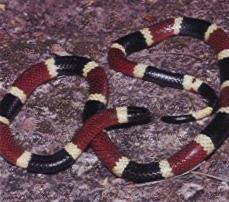
Coral Snakes

Coral Snake

Background: Approximately 40-50 species of venomous coral snakes exist in North and South America, with the greatest variety from Mexico to northern South America. A number of African and Asian coral snake species also exist. All coral snakes belong to the family Elapidae; Micrurus fulvius fulvius (eastern coral snake) and Micrurus fulvius tenere (Texas coral snake) are the most important species in the US.

Another US coral snake is Micruroides euryxanthus (Sonoran coral snake), but this is a relatively innocuous snake and no deaths have been attributed to its bite.

Coral snakes tend to be relatively shy creatures and bites are uncommon. Coral snakes account for less than 1% of venomous snakebites in the US. Most people bitten by coral snakes are handling them intentionally. Most bites occur in the spring or fall.

Pathophysiology: The coral snake venom apparatus is comprised of a pair of small, fixed, hollow fangs on the anterior aspect of the mouth through which the snake conducts venom via a chewing motion. Unlike pit vipers, such as rattlesnakes, copperheads, and cottonmouths, which strike quickly, coral snakes must hang on for a brief period to achieve significant envenomation in humans.

Coral snake venoms tend to have significant neurotoxicity, inducing neuromuscular dysfunction. They have little enzymatic activity or necrotic potential compared to most vipers and pit vipers. These venoms tend to be some of the most potent found in snakes, yet the venom yield per animal is less than that of most vipers or pit vipers. Because of the relatively primitive venom delivery apparatus, as many as 60% of those bitten by North American coral snakes may not be envenomed.

Frequency:

  • In the US: Probably less than 20 bites per year (though 61 alleged bites were reported to the American Association of Poison Control Centers in 1998)
  • Internationally: No accurate information available

Mortality/Morbidity: No deaths related to coral snake bites have been reported in the US since coral snake antivenom became available. Before that time, the estimated case fatality rate was 10%, and the cause of death was respiratory or cardiovascular failure. Patients who survive the bite may require respiratory support for up to a week and may suffer persistent weakness for weeks to months.

History:

  • The vast majority of patients bitten by coral snakes report that a brightly colored snake bit them.
  • North of Mexico City, including the US, the color pattern of the snake can be helpful in differentiating a coral snake from a harmless mimic (eg, nonvenomous milk snake).
    • In this region, all coral snakes have a red, yellow, black, yellow, red banding pattern (red and yellow touching); most harmless mimics have a red, black, yellow, black, red pattern (red and yellow separated by black).
    • South of Mexico City, the banding patterns are much more difficult to differentiate because bicolor (red and black) species also are present.
  • Onset of symptoms may be delayed up to 10-12 hours.
  • Paucity of local complaints
  • Local paresthesias (may be painful)
  • Soft tissue swelling (usually very mild)
  • Alteration of mental status
  • Complaints related to cranial nerve dysfunction (eg, diplopia, ptosis, difficulty swallowing)

Physical:

  • Impending respiratory failure
    • Respiratory distress
    • Pharyngeal spasm
    • Hypersalivation
    • Cyanosis
    • Trismus
  • Neurologic dysfunction
    • Altered mental status
    • Ptosis
    • Generalized weakness
    • Muscle fasciculations
  • Cardiovascular collapse
    • Hypotension
    • Tachycardia


Go back to HOME Page

BACK TO BITES & STINGS


  View our Privacy Statement 

* Your ability to search MLS listings is provided by Lori Klindera & George "G-II" Varrato II, Realtors with Coldwell Banker Residential Brokerage, who may contact you.  The information within this web site is copy right protected.  Lori Klindera & George "G-II" Varrato II (hereinafter referred to as Lori & "G-II") are members of the National Association of REALTORSŪ ("NAR") , but are not, sponsored, or endorsed by, the NAR. Lori & "G-II" are REALTORŪ Associates with Coldwell Residential Brokerage, Metro West, 3050 W. Agua Fria Freeway, Suite 110, Phoenix, AZ 85027. The names of other companies or associations, and their respective products and services, may be the trademarks of their respective owners. Use of such other trade and service marks is for identification and informational purposes only. 

Links to other Internet sites that are not maintained by Lori & "G-II's" WEB Master are provided solely for your convenience and information. Lori & "G-II" makes no warranties or representations about the contents of or any products or services offered in such third-party sites and recommends that you read the privacy and security policies of those sites. 

Coldwell Banker Residential Brokerage, the Coldwell Banker Residential Brokerage logo, CBSuccess.com, RealEstateInPhoenix.net, HomesInPhoenix.net, iPhoenixMLS.com, iProCenter.com/Lori_G-II, AirForceHomeBuyer.com, AirForceHomeBuyer.net, AirForceHomeBuyer.info, AirForceHomeSeller.com, AirForceHomeSeller.net, AirForceHomeSeller.info, TheValleyOfTheSun.info, TheValleyOfTheSun.net, ColdwellBanker.com, AZMoves.com and ColdwellBankerSuccess.Info are protected under federal and international trademark and copy right laws.