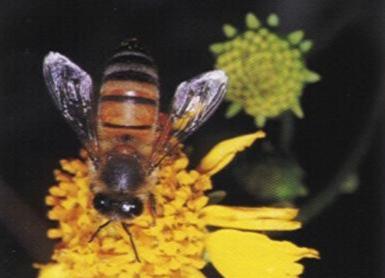
Africanized honey bees were imported to Brazil in 1956 to enhance honey
production in the tropics. Some of the bees escaped into the wild and have
gradually moved towards North America.
Africanized honey bees are the temperamental cousin of the more common
European honey bee found in Arizona. They often are called "killer
bees", but in reality their stings are less potent and painful than the
common bee sting. Contrary to portrayal in the movies, these bees do not swoop
down in mass causing death and destruction. They do defend their nesting sites
very aggressively, sometimes stinging their victims hundreds of times.
It is impossible for the average person to tell the difference between an
Africanized honey bee and the common European honey bee. Only an expert with
sophisticated lab equipment is able to distinguish between the two. Those at
highest risk are individuals who are allergic to bee stings and pets that are
penned or tied up near honey bee hives.
Do's and Don'ts
DO check your property regularly for bee
colonies. Honey bees nest in a wide variety of places, especially
Africanized honey bees. Check animal burrows, water meter boxes, overturned
flower pots, trees and shrubs.
DO keep pets and children indoors when using
weed eaters, hedge clippers, tractor power mowers, chain saws, etc. Attacks
frequently occur when a person is mowing the lawn or pruning shrubs and
inadvertently strikes a bee's nest.
DO avoid excessive motion when near a colony.
Bees are much more likely to respond to an object in motion than a
stationary one.
DON'T pen, tie or tether animals near bee
hives or nests.
DON'T destroy bee colonies or hive,
especially with pesticides. Honey bee are a vital link to U.S. agriculture.
Each year, pollination by honey bees add at least $10 billion to the value
of more than 90 crops. They also produce about $150 million worth of honey
each year.
DON'T remove bees yourself. Call the Arizona
Department of Agriculture at (602) 542-4373. You also can call your local
county health department or county extension office.
What to do if you are attacked:
Run as quickly as you can away from the bees. Do not flail or swing your
arms at them, as this may further annoy them.
Because bees target the head and eyes, cover your head as much as you can
without slowing your escape.
Get to the shelter or closest house or car as quickly as possible. Don't
worry if a few bees become trapped in your home. If several bees follow you
into your car, drive about a quarter of a mile and let the bees out of the
car.
When to call the Fire Department: Call the fire department only when emergency medical services are needed. If
someone has been stung by many bees at once or has an allergic reaction to a bee
sting, call 9-1-1. Call the fire department if someone has become trapped in a
building or car with lots of bees. Fire trucks are equipped with a foam that can
be sprayed on the bees to drown them. DO NOT call the fire department to remove
bee colonies or hives. If you want bees removed, look in the yellow pages under
"bee removal" or "beekeepers".
How to treat stings from Africanized bees:
Treating stings from Africanized bees is much the same as treating a
common bee sting. If a person is stung:
Keep the affected area below the heart
If the sting was by a bee and the stinger is still in the skin, remove it
by gently scraping against it with your fingernail, a credit card or a
knife. Be careful not to squeeze the stinger. The venom sac still will be
attached and you will inject additional venom into the area. Be sure to
remove the venom sac.
Apply cold compresses to relieve pain and swelling but do not apply ice
directly.
If it becomes difficult to breathe, call 9-1-1. Itching should quit within
a few hours. If it persists beyond two days, or if signs and symptoms of an
allergic reaction occur after an insect bite you should be seen by a doctor.
The signs and symptoms of an allergic reaction include:
Burning pain and itching at the bite site
Itching on the palms of the hands and soles of the feet